


Cambodia Climate Finance Facility (CCFF)

Driving a systemic shift towards green lending in Cambodia
The Cambodia Climate Finance Facility (CCFF) is a USD 100 million national climate lending facility designed to mobilize private sector climate finance and drive a systemic shift towards green lending in Cambodia.
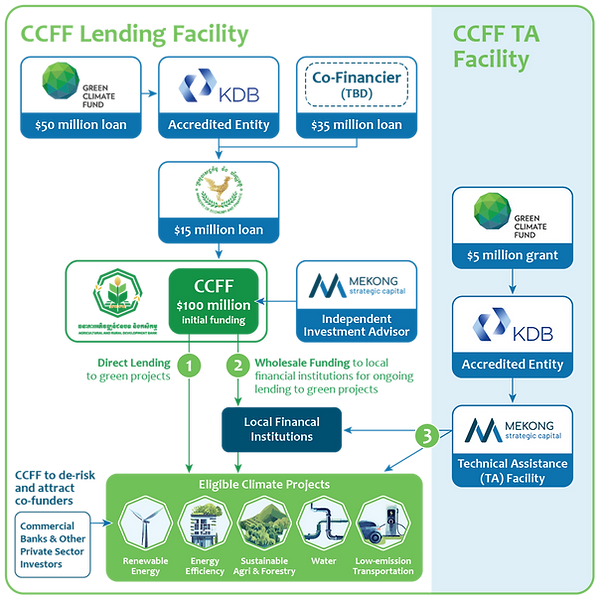
It provides long-term, concessional loans directly to Cambodian businesses, wholesale concessional funding to local financial institutions, and technical assistance that reduces transaction costs and de-risks green projects.
Approved by the Green Climate Fund (GCF) Board, CCFF is the first GCF-capitalized national climate lending facility for the private sector in Asia, and a new model for mobilizing private sector climate finance at a national level.

CCFF at a Glance
-
USD 100M total initial facility size
-
20+ years implementation period
-
11.1M tCO2e projected emissions reductions
-
1.3M people expected to benefit from improved climate resilience
-
USD 5M technical assistance facility
CCFF was conceptualised, designed, and launched by Mekong Strategic Capital, and is co-managed with the Agricultural and Rural Development Bank (ARDB), Cambodia’s national policy bank.
The facility is funded by the Green Climate Fund (GCF) and co-funded by the Ministry of Economy and Finance (MEF) through ARDB.
For an overview of the program, see the CCFF Program Factsheet.


Why CCFF Matters
Why Cambodia
Cambodia is at a critical stage of development, with both significant opportunity and growing climate risk.
-
Cambodia’s economy is the second most carbon-intensive in Southeast Asia — emitting more CO2 per unit of GDP than China, Vietnam, or Thailand — with emissions growing at 8.2% annually, outpacing GDP growth (World Bank CCDR, 2023)
-
Infrastructure being built today will shape the country’s carbon trajectory for decades
-
The country is highly exposed to climate risks, including floods, droughts, and rising temperatures
At the same time, Cambodia has set ambitious climate targets:
-
Up to 55% emissions reduction by 2035 (with international support)
-
Carbon neutrality by 2050 – the first such commitment in ASEAN
Meeting these targets requires USD 32.2 billion in total investment, of which USD 22.5 billion must come from international and private capital. Cambodia’s NDC 3.0 places private capital at the core of its financing model for the first time — and explicitly names CCFF as a scalable, replicable model for delivering it.
The CCFF is designed to help mobilise that capital and direct it towards high-impact opportunities.
The Financing Gap
Many climate-focused projects in Cambodia struggle to access financing. Not because they lack potential, but because:
-
Conventional lenders offer loan tenors too short for climate infrastructure and agricultural investments, which need 7–10+ year horizons
-
Many green borrowers cannot meet conventional collateral requirements — traditional lenders require hard assets that early-stage or first-time green projects often lack
-
International climate financiers and impact investors typically require minimum ticket sizes above USD 10M — most Cambodian climate projects are too small to access this capital
-
Local financial institutions lack the dedicated funding, tools, and experience to build green lending portfolios at scale
CCFF is designed to address these gaps:
-
Loan tenors up to 12 years, matched to the cash flow timelines of climate projects
-
Cash-flow based lending structures and broader collateral options that allow projects to be assessed on projected revenues rather than conventional land collateral, introducing project finance to Cambodia's market
-
Loan sizes starting from USD 500K, bringing Cambodia's project scale within reach of concessional climate finance
-
A dedicated wholesale funding channel and Technical Assistance Facility, giving LFIs the concessional funding and capacity-building support to build green lending portfolios profitably and at scale
The objective is not only to finance individual projects, but to drive a systemic shift in how Cambodia’s financial sector allocates capital — embedding green lending as standard practice and attracting commercial banks, impact investors, and other capital providers into Cambodia’s climate finance market.

About CCFF
How CCFF Works
Direct lending builds a pipeline of bankable green projects and demonstrates that climate lending is commercially viable. Wholesale funding scales that impact across the financial system, giving LFIs the funding and tools to grow their own green lending portfolios. Together, these channels are designed to catalyse a permanent shift in how Cambodia’s financial sector allocates capital.
DIRECT FINANCING TO BUSINESSES
Long-term loans and working capital facilities are provided directly to Cambodian companies operating or developing green projects.
-
Loan sizes from USD 500K to USD 10M
-
Long tenors aligned with project cash flows
-
Flexible structures including term loans and revolving credit facilities
-
Broader collateral options
-
Technical support available to support project preparation
See the Green Loan Factsheet for typical terms and structures.
WHOLESALE FUNDING FOR LOCAL FINANCIAL INSTITUTIONS
CCFF provides concessional funding to local financial institutions (LFIs), enabling them to expand green lending.
-
Dedicated funding lines for on-lending to eligible green projects
-
Concessional funding rates to support commercially viable green loan pricing
-
Environmental and social standards required
-
Capacity-building support to develop internal green lending capability
See the Wholesale Loan Factsheet for further detail.
What CCFF Finances
CCFF supports projects across five priority sectors supporting both mitigation and adaptation activities:

Renewable
energy

Energy
efficiency

Sustainable agi
& forestry

Water infrastructure

Low-emission transport
Examples of eligible activities include solar power generation, energy-efficient manufacturing, green buildings, climate-resilient agriculture, rural piped water systems, and EVs and charging infrastructure.
Projects must demonstrate clear climate benefits and meet CCFF eligibility criteria. See the CCFF Eligibility Guide for details.
CLIMATE CHANGE MITIGATION AND ADAPTATION SOLUTIONS TARGETED FOR FINANCING

Technical Assistance
The CCFF Technical Assistance Facility is a USD 5 million resource embedded within the program’s design. TA is delivered to reduce transaction costs and de-risk climate projects for borrowers and local financial institutions alike.
Support includes:
-
Project preparation and feasibility studies
-
Environmental and social assessments
-
Financial modelling and structuring
-
Training and capacity building for financial institutions
See the Technical Assistance (TA) Guide for full details.

CCFF Structure
Governance & Partners
CCFF is structured as a national financing platform with strong institutional backing.
-
Co-managed by: Mekong Strategic Capital and ARDB
-
Funded by: GCF and Ministry of Economy and Finance (MEF) through ARDB
-
Accredited Entity: Korea Development Bank (KDB)
-
Supported by: Australian Aid and USAID (design and development)
-
Strategic Government Partner: Ministry of Environment (MOE)
All financing is subject to defined governance, environmental, and reporting standards.
CCFF funds are held in a dedicated ring-fenced account, with all credit decisions requiring unanimous approval by the CCFF Green Credit Committee — a formal governance body comprising representatives of Mekong Strategic Capital and ARDB.
Mekong Strategic Capital's Role
The CCFF was originated, designed, and developed by Mekong Strategic Capital. This work included:
-
Conducting a feasibility assessment with GCF Readiness Funding
-
Designing the overall program and facility structures
-
Securing investor commitments
-
Building partnerships across government and development institutions
-
Establishing governance, risk, and impact frameworks
This work began in 2019 and received formal approval from the Green Climate Fund Board in March 2024. With the structure and funding arrangements finalized, CCFF became effective in November 2025.
Mekong Strategic Capital serves as Independent Investment Advisor and Executing Entity, responsible for:
-
Deal origination and structuring
-
Climate impact assessment
-
Portfolio monitoring and reporting
-
Capacity building of ARDB
-
Implementation of the Technical Assistance Facility
CCFF represents the first deployment of Mekong Strategic Capital’s approach to building climate finance platforms that can mobilise private capital at scale. Mekong Strategic Capital brings a decade of climate finance experience in the Mekong region, including facilitating USD 446M in sustainable investment across Southeast Asia as sole mandated advisor on USAID Green Invest Asia, contributing to 156M tCO2e in emissions reductions.

Climate & Impact Standards
Climate Impact & Accountability
All projects financed through CCFF must demonstrate measurable climate benefits.
-
Projects are assessed against defined eligibility criteria
-
Emissions reductions and adaptation outcomes are tracked
-
Impact is measured using recognised international methodologies
-
Regular reporting is provided to funding partners
Key indicators include greenhouse gas emissions reduced and the number of people benefiting from climate resilience measures.
Exclusions
CCFF does not finance activities that are inconsistent with its climate objectives or international standards. This includes:
-
Fossil fuel-based energy generation
-
Deforestation or ecosystem degradation
-
Projects that extend the life of fossil fuel assets
See the CCFF Eligibility Guide for the full exclusion list.
Risk Management & Responsible Financing
CCFF operates to institutional standards, with defined processes for managing financial, environmental, and social risk across all financing activities.
-
All financing follows defined credit and approval procedures
-
Projects are assessed for financial viability and climate impact
-
Environmental and social risks are screened against GCF requirements and IFC Performance Standards
-
Ongoing monitoring throughout the loan lifecycle
-
A dedicated governance framework oversees all credit decisions
The use of concessional funding helps reduce financing costs and enables support for projects that may not meet traditional commercial lending criteria, while maintaining disciplined risk management.
Gender & Inclusion
CCFF mainstreams gender across its financing activities in line with GCF requirements and international best practice.
-
All financing is screened against gender criteria, with projects assessed for their potential to expand economic opportunities for women
-
CCFF applies the 2X Criteria framework to evaluate and track gender outcomes across the portfolio
-
Wholesale borrowers are required to adopt gender policies and action plans as a condition of financing
-
A dedicated Gender Policy governs CCFF’s approach throughout the financing lifecycle

Frequently Asked Questions

How to Participate
Who CCFF Works With
CCFF is designed to work with a range of stakeholders:
Businesses
Access long-term financing for climate-focused projects, with support to prepare strong applications.
Local Financial Institutions
Access funding and technical support to develop green loan portfolios.
Investors & Partners
Participate in a structured, institutionally governed platform with measurable climate impact.
Apply for Financing
Organisations interested in CCFF financing are encouraged to get in touch to discuss eligibility and next steps.
FOR BUSINESSES
Developers of climate-focused projects can apply for direct financing.
Typical process:
-
Initial discussion to assess eligibility
-
Submission of basic project information
-
Support (if needed) to strengthen project readiness
-
Credit and impact assessment
Technical assistance may be available to support project preparation.
Before applying, it is recommended to review the CCFF Eligibility Guide, Green Loan Factsheet and Green Loan Process Guide.
FOR LOCAL FINANCIAL INSTITUTIONS
Local financial institutions can access funding to expand green lending.
Typical process:
-
Expression of interest
-
Assessment of green loan pipeline and institutional readiness
-
Technical support (if required)
-
Establishment of a funding facility
Further detail is available in the Wholesale Loan Factsheet.
Further information
Contact Us
For initial discussions or further information please email the Climate Finance team at Mekong Strategic Capital.
Resources
